|
CLAS with ZMax and a special 3rd party solution |
|
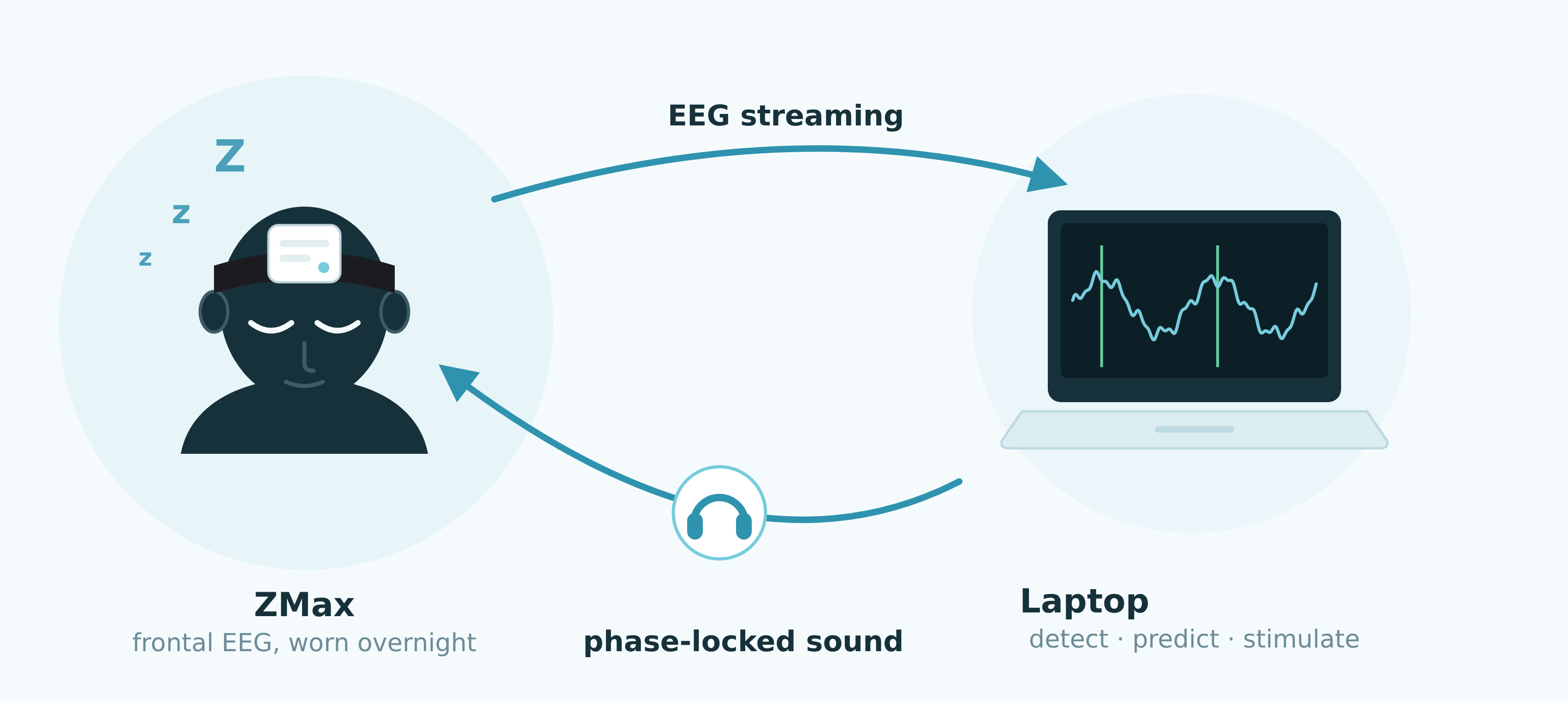
Closed-Loop Auditory Stimulation with ZMaxClosed-loop auditory stimulation (CLAS) is an established method for modulating slow-wave activity during deep sleep. By detecting ongoing slow oscillations and delivering brief auditory stimuli at a specific phase - typically the up-state - researchers can influence sleep dynamics in a controlled and time-locked manner.
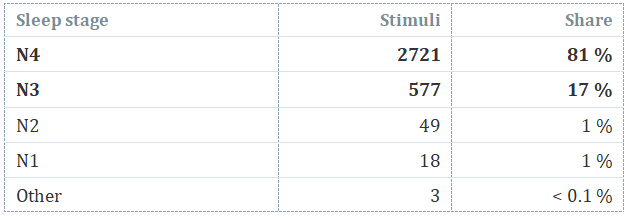
Despite its scientific promise, CLAS has traditionally required custom signal-processing pipelines, real-time programming expertise, and laboratory-grade EEG systems. Implementing reliable phase-locked stimulation often meant building and validating a complex technical setup before the first participant could even be tested. Selective Stimulation During Deep SleepClosed-loop stimulation is only meaningful if it is delivered during the appropriate sleep stage. The software continuously tracks slow delta waves and restricts stimulation to deep NREM sleep, enabling controlled and reproducible CLAS protocols. 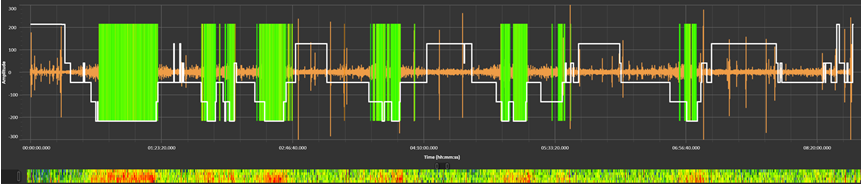
Selectivity is near-total: in the above example, 98 % of the 3368 stimuli were delivered in deep sleep (N3-N4), and fewer than 2 % in light sleep.
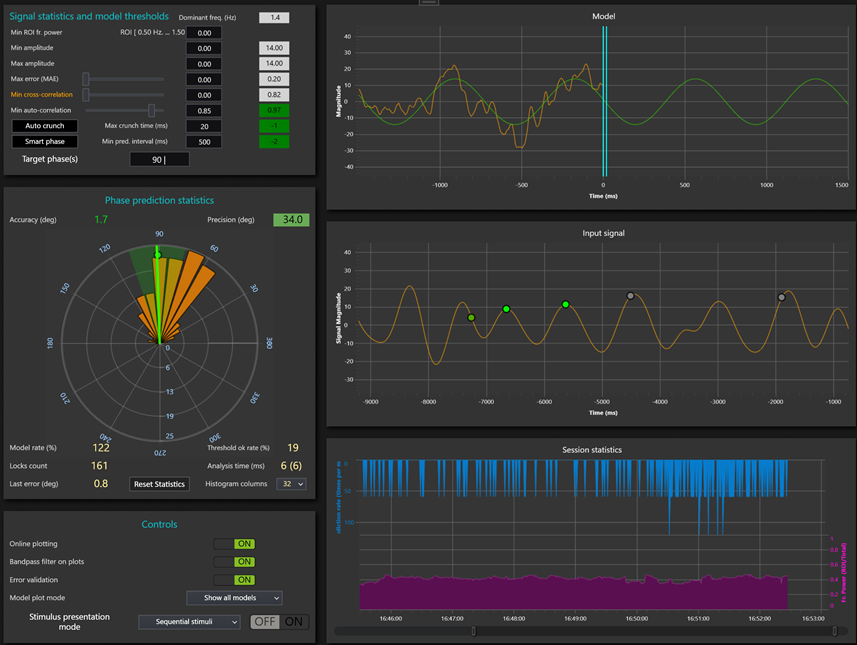
Precise Phase Targeting of Slow OscillationsOnce slow waves are detected, the software predicts the optimal moment within the oscillation and delivers auditory stimulation at the selected target phase(s) - for example, at the up-state peak used in classical CLAS protocols. Phase locking operates with millisecond resolution and automatically compensates for hardware latencies to ensure accurate biological timing. 
Real-Time Control and MonitoringEach stimulus comes from a model fitted to the ongoing oscillation, and various quality thresholds can be applied before a stimulus is allowed. Accuracy and precision are reported live, so a protocol can be checked and tuned while the session runs.
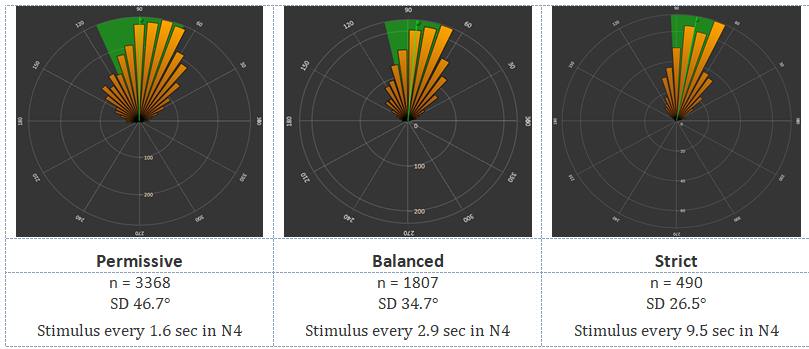
Quantifying Phase-Locking AccuracyEvery stimulus is logged with the phase it actually hit, so locking accuracy is measured rather than assumed. The companion analysis tool provides a full offline analysis of the night; among its outputs, two numbers summarize phase-locking performance - how many stimuli were delivered, and how tightly they clustered around the target phase. Flexibility and ControlCLAS protocols can be configured using built-in presets, customized as needed, and executed on standard PC or tablet hardware. Signal and stimulus latencies are compensated automatically. Researchers can replay previously recorded data to optimize parameters before running participants. The millisecond processing speed of the phase-locking algorithm makes it capable of running many streams in parallel - allowing synchronized locking on separate channels, in separate frequency bands, and even across several participants on a single machine. Ready to Implement CLAS?Interested in implementing closed-loop stimulation with ZMax? Contact us to get started:
Whether you are planning a pilot experiment or a full study, we can help you move from concept to implementation quickly.
Or, if you want to roll your own solution, click here. |
|
|